Scars and Electro-Acupuncture: How Old Injuries May Affect the Whole Body
A scar may look like a small mark on the skin, but the story behind it can be much bigger.
Whether it comes from surgery, an injury, a C-section, a joint replacement, or an old accident, a scar represents the body's process of healing. And although many scars heal without causing ongoing problems, some can remain sensitive, restrict movement, or affect how nearby tissues glide and function.
In Traditional Chinese Medicine (TCM), scars are also viewed through the concept of Qi and Blood circulation. When an injury disrupts the normal flow of Qi and Blood, the resulting area may be described as a form of stagnation.
This raises an interesting question: Can an old scar influence how the rest of the body feels and moves?
In some cases, the answer is yes. Understanding how scars heal and how treatments such as electro-acupuncture may help address scar-related symptoms, can open up another perspective on chronic pain and movement restrictions.
WHAT HAPPENS WHEN A SCAR FORMS?
When the skin or deeper tissues are injured, the body begins a complex repair process. Collagen and other structural components help rebuild the damaged area.
Scar tissue is not identical to the tissue it replaces. Its structure and organization can differ from the surrounding skin, fascia, and connective tissue.
Depending on the original injury and the healing process, a scar may be:
Raised or thickened
Firm or less flexible
Sensitive to pressure
Itchy or uncomfortable
Numb or associated with altered sensation
Adherent to deeper tissues
Restrictive during certain movements
Some scars heal with very few lasting effects. Others can remain uncomfortable long after the original wound has closed.
The depth of the original injury matters, too. A scar from a minor cut is different from one that follows abdominal surgery, a knee replacement, or a significant muscle injury.
A scar may involve more than the visible surface of the skin. The tissues underneath it may also have been affected.
SCARS THROUGH THE LENS OF TRADITIONAL CHINESE MEDICINE
Some practitioners consider the location of a scar in relation to acupuncture meridians, which are pathways in the traditional TCM system.
For example, a scar that crosses an area associated with a particular meridian may be considered as part of the person's overall treatment pattern.
It is important to distinguish this traditional framework from modern anatomy: meridians and Qi are not established anatomical structures in the same way as nerves, blood vessels, and connective tissue. Nevertheless, the TCM framework provides practitioners with a way to consider local symptoms in the context of the whole person.
HOW CAN A SCAR AFFECT MORE THAN THE AREA WHERE IT FORMED?
A scar does not automatically cause problems elsewhere in the body. However, certain scars may influence movement, sensation, or the way someone uses a particular body part.
There are several possible explanations.
1. Changes in Tissue Mobility
Skin and connective tissues normally move and glide relative to one another.
After an injury or surgery, scar tissue may adhere to deeper structures or become less mobile. When this happens, movement involving the affected area may feel tight or restricted.
For example, a scar following abdominal surgery may feel uncomfortable when someone stretches, twists, or fully extends the trunk.
The issue is not that the scar is necessarily blocking energy throughout the body. Rather, local changes in tissue mobility may affect comfortable movement and contribute to compensatory patterns.
2. Changes in Sensation
Scars can sometimes involve small sensory nerves.
Some people experience numbness, tingling, tenderness, burning, or sensitivity around a healed incision. In certain cases, nerve irritation or a neuroma may contribute to persistent pain.
These symptoms can change how a person moves or responds to pressure.
Acupuncture treatment should take altered sensation into account, especially when an area is numb or unusually sensitive.
3. Protective Movement Patterns
When an area has been painful, the nervous system may learn to protect it.
Someone with a painful abdominal scar may avoid fully extending the trunk. A person recovering from knee surgery may continue to favor the opposite leg. Someone with a shoulder incision may unconsciously limit reaching.
Over time, these changes can affect strength, flexibility, and movement habits.
The resulting discomfort may be felt beyond the scar itself.
4. Local Sensitivity and the Nervous System
Pain is influenced by more than tissue structure alone. Sensory input, the nervous system, previous experiences, stress, and expectations can all influence how discomfort is experienced.
A scar that remains painful may become part of a broader pain pattern, particularly when the original injury was significant.
This does not mean that the pain is imaginary. It means that pain and tissue healing are complex processes involving multiple systems.
REAL-WORLD EXAMPLES: WHEN A SCAR DESERVES A CLOSER LOOK
Consider a few situations in which scar assessment may be useful.
Example 1: A C-Section Scar and Abdominal Tightness
After a Cesarean section, the incision may heal well on the surface while the surrounding tissues remain sensitive or feel restricted.
Some people notice pulling around the scar when standing upright, stretching, exercising, or changing positions.
In selected cases, scar sensitivity or reduced tissue mobility may contribute to discomfort during movement.
A treatment plan might include appropriate scar mobilization, physical therapy, and—when suitable—acupuncture directed toward the surrounding area.
Persistent abdominal or pelvic pain should also be evaluated to rule out other causes.
Example 2: A Knee Replacement Scar and Restricted Movement
Following knee replacement surgery, a patient may experience stiffness or discomfort around the incision even after the wound has healed.
Scar sensitivity can be one contributing factor, although joint stiffness, swelling, muscle weakness, and other postoperative changes may also be involved.
A comprehensive rehabilitation plan may include prescribed exercises, mobility work, and other interventions recommended by the surgical team.
Acupuncture may be considered as a complementary option for selected symptoms, but it should never replace postoperative rehabilitation or evaluation of a painful or swollen joint.
Needling directly into or around a surgical scar requires appropriate clinical judgment and should only be considered once healing status and surgical restrictions have been reviewed.
Example 3: An Old Ankle Injury and Changes in Walking
Imagine someone who sustained a deep cut near the ankle years ago.
The wound healed, but the scar remains sensitive when shoes rub against it. The person begins to alter foot placement to avoid the discomfort.
That change may influence walking mechanics and place different demands on the calf, knee, or hip.
The scar may be one factor in the overall pattern, but it would be inaccurate to assume it is the sole cause of every symptom farther up the leg.
An assessment should consider the ankle joint, strength, nerve function, footwear, and the person's walking pattern.
Example 4: A Shoulder Surgery Scar and Guarded Movement
After shoulder surgery, some people develop tenderness around the incision or feel pulling during certain arm movements.
If movement remains guarded, the surrounding muscles may become tense and shoulder mobility may be affected.
In these cases, the scar is one part of a larger rehabilitation picture.
The surgeon or physical therapist can determine whether the restriction is related to the scar, the joint, the repaired tissues, or another cause. Acupuncture may be incorporated when appropriate.
The common thread in these examples is not that every scar disrupts the whole body. It is that a scar can sometimes be one overlooked contributor to a person's movement or pain pattern.
WHAT IS ELECTRO-ACUPUNCTURE?
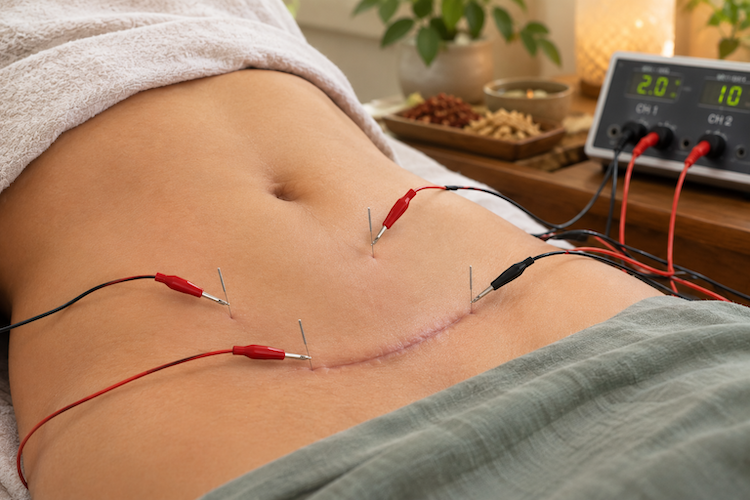
Electro-acupuncture combines traditional acupuncture needles with a low-level electrical current delivered through a specialized device.
After needles are placed by a qualified practitioner, small clips connect selected needles to the device. The practitioner adjusts the stimulation according to the treatment goal and the patient's tolerance.
The sensation is usually described as a gentle pulsing, tapping, or rhythmic muscle response. It should not feel painfully intense.
Electro-acupuncture is used in some clinical settings for musculoskeletal pain and other symptoms. Research suggests that acupuncture may influence pain-processing pathways and nervous-system activity, although the evidence varies by condition and treatment protocol.
When addressing a scar, the objective is not to send electricity through a scar to “clear blocked energy.” Instead, treatment may be designed to address surrounding pain, muscular tension, or altered sensory input, depending on the individual.
HOW MIGHT ELECTRO-ACUPUNCTURE HELP WITH SCAR-RELATED SYMPTOMS?
The role of electro-acupuncture depends on the scar, the symptoms, and the underlying tissue condition.
Potential treatment goals may include the following.
Supporting Pain Modulation
Acupuncture is studied for its effects on pain, including how the nervous system processes sensory information.
For someone with persistent discomfort around a healed scar, acupuncture may be considered as part of a broader pain-management plan.
Addressing Surrounding Muscle Tension
A painful or restrictive scar may contribute to protective movement patterns.
Depending on the area, an acupuncturist may treat nearby muscles or other relevant points to help address muscular tension and discomfort.
Electro-acupuncture may be considered when stimulation of selected muscles or pain-related pathways is part of the treatment plan.
Supporting Comfortable Movement
If a scar is associated with guarding or discomfort, reducing symptoms may help someone participate more comfortably in rehabilitation.
For example, a patient with a healed knee incision may find movement easier when pain and surrounding muscle tension are better managed.
That does not mean electro-acupuncture mechanically releases adhesions or remodels scar tissue. Direct scar mobilization and rehabilitation, when appropriate, address different aspects of the problem.
DOES ELECTRO-ACUPUNCTURE BREAK UP SCAR TISSUE?
Some practitioners may use acupuncture around a scar with the aim of improving symptoms or supporting comfortable movement. Techniques and evidence vary, and the effects should not be overstated.
For scars that are thick, raised, adherent, or painful, other treatments may be more directly relevant, including:
Scar massage or mobilization when medically appropriate
Physical therapy
Silicone gel or sheets for selected raised scars
Dermatologic treatment for hypertrophic scars or keloids
Specialist evaluation for suspected nerve entrapment or neuroma
Surgical consultation for selected cases
The most suitable approach depends on the type of scar and the problem being treated.
HOW DOES THIS FIT INTO THE TCM CONCEPT OF ENERGY FLOW?
In TCM, acupuncture treatment may be planned around the location of the scar, the meridians traditionally associated with that area, and the patient's overall pattern of symptoms.
IS IT SAFE TO USE ELECTRO-ACUPUNCTURE ON A SCAR?
Not every scar is suitable for direct needling.
A scar should be fully healed before any needling is considered near it. The practitioner should assess the skin, the underlying tissue, the original procedure, and any medical restrictions.
Extra caution is needed when a scar is:
Recent or incompletely healed
Red, hot, draining, or increasingly painful
Associated with unexplained swelling
Located over an area with altered sensation
Related to recent surgery or an implanted medical device
Electro-Acupuncture should not be used if someone has a pace-maker or has seizures.
LOOKING BEYOND THE SCAR
A scar may be a small part of the body visually, but its history can be significant.
For some people, it is simply a reminder of an injury that healed well. For others, it may be associated with sensitivity, restricted movement, or compensatory patterns that deserve further assessment.
In Traditional Chinese Medicine, scars can be considered through the framework of Qi and Blood stagnation. In modern clinical care, the focus is on tissue healing, sensation, mobility, pain, and function.
Electro-acupuncture may have a role as a complementary option for selected scar-related symptoms, but it should be used with realistic expectations and alongside appropriate medical care.
The goal isn't to erase the body's history. It's to understand whether that history is still affecting how you feel and move and to choose the right treatment for the problem that's actually present.
At Kara Acupuncture & Wellness, looking at the whole person means paying attention not only to where pain occurs, but also to previous injuries, surgical history, movement patterns, and the ways the body adapts over time.
Sometimes, a scar is simply a scar. Other times, it may be one piece of a much larger clinical picture.