
What Is the Interstitium? An Acupuncture Perspective on the Body’s Hidden Communication Network
This week there was a New York Time’s article that talked about the connection of acupuncture meridians to the interstitium. If you have a subscription, it’s worth the read! They did a great job on the graphics. You can get the article here: Inside the Interstitium, the Human Body’s Hidden Pathways - The New York Times
In recent years, scientists have renewed interest in a fascinating structure within the human body known as the interstitium—a vast network of fluid-filled spaces woven throughout connective tissues. Some researchers believe this system may play a major role in communication, circulation, immune activity, and even chronic inflammation.
For many acupuncturists, this discovery feels surprisingly familiar.
Traditional Chinese Medicine (TCM) has long described the body as an interconnected network through which Qi, blood, fluids, and information travel. While modern science and acupuncture use different languages, emerging research on fascia and the interstitium is creating intriguing conversations about how the body communicates internally.
WHAT IS THE INTERSTITIUM?
The interstitium refers to a network of microscopic, fluid-filled spaces found throughout the body, especially within connective tissue surrounding:
Muscles
Organs
Blood vessels
Nerves
Fascia
Researchers describe it as a dynamic tissue system that may function as a kind of fluid highway, helping transport mechanical signals, immune cells, and interstitial fluid throughout the body.
Rather than viewing the body as isolated parts, the interstitium supports the idea that the body functions more like an interconnected web.
THE FASCIAL CONNECTION
Modern anatomy increasingly recognizes the importance of fascia—the connective tissue network surrounding muscles and organs.
Interestingly, many acupuncture meridians appear to align closely with:
Fascial planes
Connective tissue pathways
Neuromuscular junctions
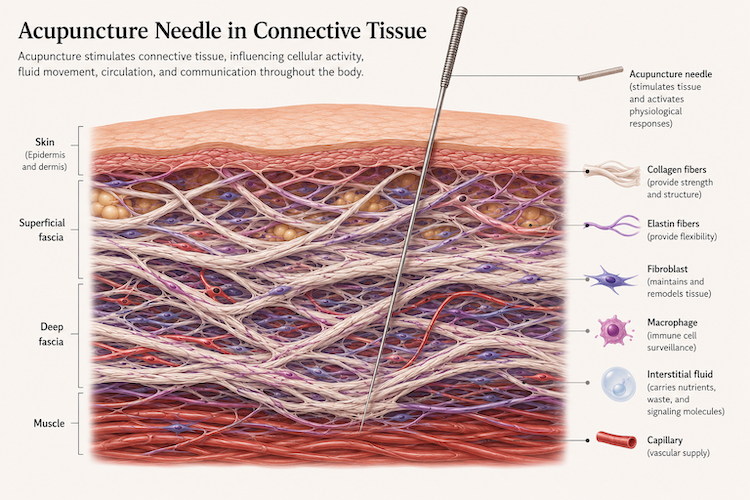
Research suggests acupuncture may stimulate fibroblasts, connective tissue cells, and immune signaling pathways through mechanical interactions within these tissues.
From an acupuncture perspective, this is particularly compelling because TCM has long emphasized that health depends on the smooth movement of Qi and fluids through interconnected pathways.
AN ACUPUNCTURE VIEW: COULD THE INTERSTITIUM RELATE TO MERIDIANS?
In acupuncture there is a network of channels called meridians, through which Qi and blood circulate.
Historically, critics questioned whether these pathways had any anatomical basis because they were not visible through conventional dissection techniques.
A well-known study by researcher Helene Langevin suggested that twisting an acupuncture needle mechanically interacts with connective tissue and fibroblasts, potentially affecting signaling through fascia and interstitial tissue.
Now, some researchers are exploring whether the interstitium and fascia may help explain aspects of acupuncture’s effects—not as literal “energy tubes,” but as part of a complex communication system involving:
Mechanical signaling
Nervous system regulation
Fluid dynamics
Connective tissue responsiveness
Importantly, scientists have not proven that the interstitium equals acupuncture meridians, and the relationship remains theoretical. However, growing research is investigating how needling affects connective tissue, immune signaling, and neurovascular pathways.
HOW ACUPUNCTURE MAY INTERACT WITH THE INTERSTITIUM
When an acupuncture needle is inserted, several things happen simultaneously:
1. Mechanical Stimulation of Connective Tissue
The needle gently twists and pulls on collagen fibers and fascia, creating measurable tissue responses.
2. Nervous System Activation
Acupuncture stimulates sensory nerves that communicate with the spinal cord and brain.
3. Fluid and Circulatory Changes
Needling can increase microcirculation and influence local tissue hydration and inflammatory signaling.
4. Immune Modulation
Emerging evidence suggests acupuncture may influence immune cells such as macrophages within connective tissue environments.
This aligns with the growing understanding that connective tissue is not passive “packing material,” but an active communication system throughout the body.
THE NERVOUS SYSTEM AND WHOLE-BODY COMMUNICATION
One of the most interesting ideas surrounding the interstitium is that it may help explain how localized stimulation can create widespread effects.
Patients often notice that acupuncture performed in one area influences symptoms elsewhere in the body. From a biomedical perspective, this likely involves multiple overlapping systems:
Fascia and connective tissue
Nervous system pathways
Immune signaling
Circulatory changes
Acupuncture appears to operate through a combination of these mechanisms rather than a single isolated effect.
BRIDGING ANCIENT AND MODERN MEDICINE
The conversation around the interstitium reflects something larger happening in medicine: a growing effort to bridge traditional healing systems with modern scientific understanding.
That does not mean every ancient explanation has been scientifically validated. It also does not mean modern science has fully explained acupuncture.
What it does suggest is that:
The body is more interconnected than previously believed
Connective tissue plays a much larger role in health than once assumed
Acupuncture likely works through measurable physiological mechanisms involving multiple body systems
Even skeptics acknowledge that research into fascia, mechanotransduction, and neuroimmune signaling is expanding rapidly.
WHY THIS MATTERS FOR PATIENTS
Understanding the interstitium may eventually help explain why acupuncture can influence:
Pain
Mobility
Inflammation
Stress regulation
Nervous system balance
Rather than viewing the body as separate parts, both acupuncture and interstitium research point toward a model of health based on communication, flow, and connectivity.
THE ACUPUNCTURIST’S TAKEAWAY
From an acupuncture perspective, the interstitium represents an exciting shift in how we understand the body—not as isolated structures, but as a living network of communication and responsiveness.
While more research is still needed, emerging studies on fascia, connective tissue, and fluid dynamics are beginning to explore concepts that echo what Chinese medicine has described for centuries:
Movement matters
Flow matters
Connection matters
Acupuncture may not simply act on muscles or nerves alone—it may influence the body through an integrated web of connective tissue, fluid exchange, nervous system regulation, and immune communication.
And science is only beginning to map that network.