
The Neurobiology of Stress: How Acupuncture Stimulates Neurons to Help Reduce Systemic Inflammation
What exactly is happening when you are stressed? I’ve often wondered why some of my patients are more stressed out than others. The external factors can vary greatly, but one person’s stress response to a minor stressor can feel catastrophic compared to others.
Stress is often thought of as an emotional experience, but its effects extend far beyond the mind. Chronic stress can alter brain function, disrupt the nervous system, and trigger widespread inflammation throughout the body. Over time, this persistent inflammatory state has been linked to chronic pain, heart disease, autoimmune disorders, depression, diabetes, and many other health conditions.
For thousands of years, Traditional Chinese Medicine (TCM) has viewed acupuncture as a way to restore balance within the body. Today, modern neuroscience is beginning to uncover how this ancient therapy interacts with the nervous system. One of the most exciting discoveries comes from researchers at Harvard Medical School, who identified specific neurons that allow electro-acupuncture to activate powerful anti-inflammatory pathways. Their findings provide a biological explanation for how acupuncture may influence the body's response to inflammation. While these mechanistic studies were conducted in mice, they offer valuable insight into how acupuncture affects the nervous system and continue to guide human research.
STRESS BEGINS IN THE BRAIN
When the brain perceives danger—whether physical or emotional—it activates the sympathetic nervous system, commonly known as the "fight-or-flight" response.
During this process, the body releases stress hormones such as:
Cortisol
Adrenaline
Noradrenaline
These hormones are lifesaving during true emergencies, but when stress becomes chronic, they remain elevated longer than they should.
Over time, chronic stress may contribute to:
Increased muscle tension
Elevated blood pressure
Poor sleep
Digestive problems
Weakened immune regulation
Persistent inflammation
Increased pain sensitivity
Rather than protecting the body, an overactive stress response can keep the immune system in a constant state of low-grade activation.
THE CONNECTION BETWEEN STRESS AND INFLAMMATION
The nervous and immune systems communicate continuously.
When stress hormones remain elevated, immune cells begin releasing inflammatory proteins called cytokines. Although these cytokines help fight infection, excessive production can promote chronic inflammation and contribute to pain, fatigue, brain fog, and delayed healing.
Scientists now recognize that reducing stress is not simply about improving mood—it can also influence inflammatory activity throughout the body.
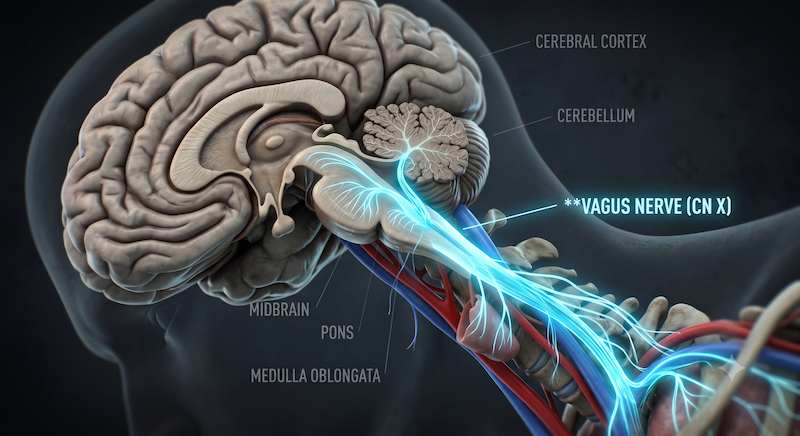
THE VAGUS NERVE: THE BODY’S ANTI-INFLAMMATORY HIGHWAY
One of the most important discoveries in neuroscience has been the role of the vagus nerve.
As the longest cranial nerve, the vagus nerve connects the brain to the:
Heart
Lungs
Digestive organs
Immune system
When activated, it shifts the body into the "rest-and-digest" state by:
Slowing heart rate
Improving digestion
Supporting recovery
Reducing stress responses
Helping regulate inflammation
Researchers call one of these mechanisms the vagal-adrenal anti-inflammatory pathway, in which signals traveling through the vagus nerve ultimately influence the adrenal glands and help suppress excessive inflammatory responses.
HARVARD RESEARCHERS DISCOVER HOW ACUPUNCTURE ACTIVATES ANTI-INFLAMMATORY NEURONS
In 2021, neuroscientists at Harvard Medical School and collaborators published groundbreaking research in Nature that identified a specific population of sensory neurons responsible for acupuncture's anti-inflammatory effects in mice.
The researchers found that:
Low-intensity electro-acupuncture at the leg acupoint ST36 (Zusanli) activated a specialized group of sensory neurons.
These neurons signaled the brainstem, which then activated the vagal-adrenal axis.
Activation of this pathway prompted the adrenal glands to release catecholamines, including dopamine.
These signals significantly reduced the production of inflammatory cytokines during experimentally induced systemic inflammation.
Importantly, the effect depended on stimulating the appropriate body region and the correct type of sensory nerve fibers. The findings demonstrated that acupuncture's effects are not random but involve identifiable neuroanatomical pathways.
ACUPUNCTURE AND THE STRESS RESPONSE
Beyond inflammation, numerous studies suggest acupuncture influences the autonomic nervous system by encouraging a shift away from sympathetic ("fight-or-flight") dominance toward greater parasympathetic activity.
Patients frequently report:
Feeling calmer after treatment
Improved sleep
Reduced muscle tension
Better digestion
Lower anxiety
Increased resilience to stress
Researchers believe these effects may result from a combination of changes in brain activity, neurotransmitter release, and autonomic regulation.
THE NEUROBIOLOGY OF PAIN RELIEF
Stress and inflammation often amplify pain by making the nervous system more sensitive.
Acupuncture appears to help interrupt this cycle by:
Activating natural pain-inhibiting pathways
Increasing endorphin release
Improving local circulation
Reducing muscle tension
Modulating inflammatory signaling
Supporting nervous system regulation
Rather than simply masking pain, acupuncture may help address some of the biological processes contributing to it.
WHAT THIS MEANS FOR PATIENTS
Although the Harvard research was performed in animal models and further human studies are needed, the findings provide compelling evidence that acupuncture can engage measurable neural circuits involved in immune regulation.
This growing understanding helps explain why acupuncture is commonly incorporated into comprehensive care for conditions such as:
Chronic neck and back pain
Arthritis
Fibromyalgia
Migraines
Stress-related disorders
Digestive dysfunction
Recovery after injury
For many people, acupuncture complements conventional medical care by helping regulate the body's stress response and supporting overall well-being.
A MEETING OF ANCIENT WISDOM AND MODERN NEUROSCIENCE
Traditional Chinese Medicine has long described acupuncture as restoring the body's balance and promoting the smooth flow of Qi. Modern neuroscience describes these effects differently, focusing on neural circuits, autonomic pathways, neurotransmitters, and immune regulation.
Although the language differs, both perspectives recognize that stimulating specific points on the body can influence systems far beyond the skin or muscles.
As research continues, acupuncture is increasingly viewed not only as a pain-management tool but also as a therapy capable of interacting with the nervous system in measurable and biologically meaningful ways.
As always, seek a Licensed Acupuncturist (L.Ac.)