
Leg Length Discrepancy: How Acupuncture Can help fix the Root Cause of Hip Misalignments
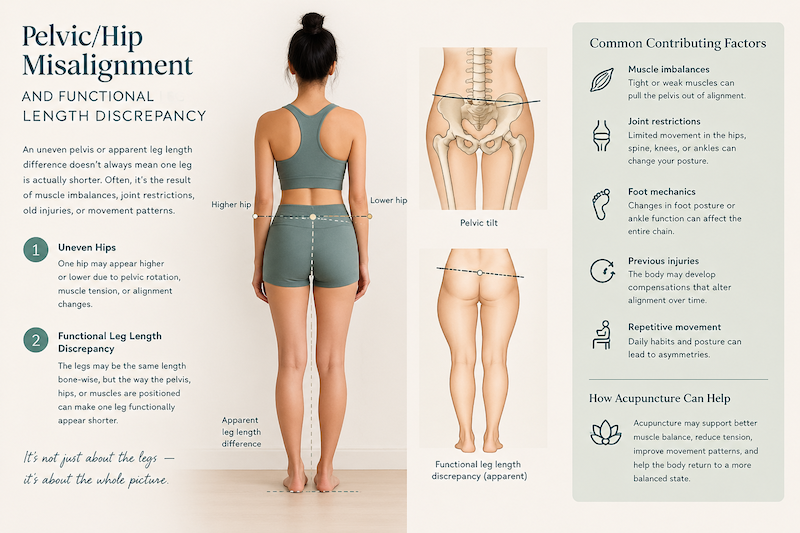
Have you ever been told that one leg is shorter than the other? Or perhaps you notice that one hip sits higher, one shoe wears differently, or you tend to shift your weight onto one side when standing?
These changes can sometimes be related to a leg length discrepancy (LLD) - but there is an important distinction to make.
Not every apparent difference in leg length means that the bones of one leg are actually shorter. In many people, the difference is functional, meaning that changes in the pelvis, hips, muscles, joints, or movement patterns make one leg appear shorter or longer.
Understanding the difference between a structural leg length discrepancy and a functional one can be an important step toward addressing the underlying cause of hip and pelvic imbalance.
WHAT IS LEG LENGTH DISCREPANCY?
Leg length discrepancy refers to a difference in the length or apparent length of the legs.
There are two broad categories:
Structural leg length discrepancy
A structural discrepancy occurs when the bones of one leg are actually different in length.
This can develop because of:
Differences present from birth
Previous fractures or injuries
Growth-plate injuries
Hip or knee problems
Joint replacement or other orthopedic procedures
Differences in bone development
A true structural discrepancy is an anatomical difference and may require specific orthopedic or physical therapy assessment.
Functional leg length discrepancy
A functional discrepancy is different.
The bones may be essentially the same length, but changes in the way the pelvis, hips, knees, ankles, or muscles are positioned can make one leg functionally appear shorter or longer.
For example, tightness in the hip muscles, pelvic rotation, altered foot mechanics, or differences in muscle activation can influence how the pelvis sits and how the legs contact the ground.
This is why simply measuring the legs—or immediately placing a lift in one shoe—may not always address the underlying problem.
HOW CAN HIP MISALIGNMENT AFFECT LEG LENGTH?
Think of the pelvis as the foundation connecting your spine and legs.
If the pelvis rotates, tilts, or shifts because of muscle tension, joint restriction, habitual posture, or an altered movement pattern, the relationship between the pelvis and legs can change.
You might notice:
One hip appearing higher than the other
One leg appearing longer
Uneven weight distribution
Difficulty standing evenly
One foot turning outward more than the other
Tightness on one side of the lower back
Hip or buttock discomfort
Knee discomfort
Recurrent muscle tightness
Changes in walking or running mechanics
The body often adapts to these changes.
A small imbalance at the foot can influence the knee. The knee can influence the hip. The pelvis can influence the lower back. The result can become a chain of compensations rather than one isolated problem.
THE BODY WORKS AS A CHAIN
One of the most useful ways to understand hip and pelvic alignment is to stop looking at the hip by itself.
Your body is an interconnected kinetic chain.
For example:
Foot → ankle → knee → hip → pelvis → spine
If movement is restricted or altered at one point in this chain, other areas may compensate.
Imagine someone who consistently places more weight on the outside of one foot. Over time, that person may develop changes in ankle movement, knee positioning, hip muscle activation, and pelvic mechanics.
The hip may eventually become tight—not because the hip was necessarily the original problem, but because it has been compensating for something farther down the chain.
This is why identifying the source of the compensation can be more useful than simply trying to force the hips back into position.
COMMON CAUSES OF FUNCTIONAL HIP IMBALANCE
There isn't one universal cause of an uneven pelvis. Several factors can contribute.
1. Muscle imbalance
Muscles around the hips and pelvis help stabilize the body during standing and movement.
If certain muscles become chronically tight while others become weak or underactive, the pelvis may not move or stabilize symmetrically.
Commonly involved areas include:
Hip flexors
Gluteal muscles
Adductors
Hamstrings
Quadratus lumborum
Deep rotators of the hip
2. Previous injuries
The body frequently develops compensatory movement patterns after an injury.
Even after an ankle, knee, hip, or back injury has healed, someone may continue favoring one side.
Over time, the original injury may no longer hurt, while the compensation remains.
3. Repetitive movement
Your everyday habits matter.
Standing with your weight on one leg, crossing the same leg repeatedly, carrying a child or bag on one side, sitting for prolonged periods, or repeatedly performing an activity in the same direction can contribute to asymmetrical movement patterns.
Athletes may also develop imbalances from repetitive sport-specific movements.
4. Foot and ankle mechanics
The feet are the body's connection to the ground.
Changes in foot posture or ankle mobility can influence how the knees and hips move above them.
For some people, addressing the foot or ankle may therefore be an important part of addressing an apparent pelvic or leg-length imbalance.
5. Joint mobility
Restricted movement in the hip, sacroiliac region, ankle, or other joints can alter how the body distributes movement.
When one joint doesn't move efficiently, another may compensate.
WHY “FIXING THE HIP” ISN’T ALWAYS THE ANSWER
If your pelvis appears uneven, it can be tempting to think:
“My hip is out of alignment. I need someone to put it back.”
But the body is more complicated than that.
An uneven pelvis may be the result of muscle tension, joint restriction, altered movement, previous injury, or another mechanical issue.
If the underlying contributor isn't addressed, repeatedly trying to reposition the pelvis may provide only temporary changes.
A more comprehensive approach asks:
Why is the body holding this position in the first place?
That is where assessment becomes important.
HOW ACUPUNCTURE MAY HELP
From an acupuncture perspective, treatment is not simply about trying to “straighten” the pelvis.
Instead, an acupuncturist may look at areas of tension, restricted movement, pain patterns, and how different parts of the body are interacting.
Treatment may include acupuncture directed toward:
Tight hip muscles
Gluteal muscles
Lower back
Hamstrings
Hip flexors
Quadratus lumborum
Areas surrounding the sacroiliac region
Lower leg and foot muscles
The goal is to help reduce excessive muscular tension, support comfortable movement, and encourage better neuromuscular balance.
In some cases, electro-acupuncture may also be incorporated to stimulate specific muscles or areas involved in movement and rehabilitation.
ACUPUNCTURE IS NOT A SUBSTITUTE FOR STRUCTURAL ASSESSMENT
This distinction is particularly important with leg length discrepancy.
If there is a true structural difference in bone length, acupuncture cannot make one bone grow longer or shorten another.
Likewise, significant hip, knee, spinal, or foot problems may require evaluation by a physician, physical therapist, podiatrist, or other qualified healthcare professional.
A comprehensive evaluation can help determine whether the apparent discrepancy is:
Structural
Functional
Related to joint mechanics
Related to muscle imbalance
Related to foot or ankle mechanics
Or a combination of several factors
WHAT ABOUT SHOE LIFTS?
Shoe lifts or orthotics can be appropriate for some people with a clinically significant structural leg length difference.
However, they aren't automatically the solution for every person who appears to have one leg shorter.
If the apparent difference is primarily functional, addressing movement, strength, mobility, and the underlying contributor may be more appropriate than simply adding height beneath one foot.
That is why an individualized assessment is valuable before making significant changes to footwear.
WHAT YOU CAN DO AT HOME
If you've noticed an uneven hip or suspected leg length difference, start by paying attention to your movement habits.
Notice how you stand
Do you consistently rest your weight on one leg?
Try standing with your feet approximately hip-width apart and distributing your weight evenly.
Change positions regularly
Avoid staying in one sitting or standing position for long periods.
Small movement breaks throughout the day can help reduce stiffness and prevent habitual postures from becoming deeply ingrained.
Strengthen the hips
Exercises targeting the glutes and other hip stabilizers can help support pelvic control.
Examples may include:
Glute bridges
Side-lying hip abduction
Clamshells
Step-ups
Controlled single-leg balance
Exercises should be individualized, particularly if you have pain or a previous injury.
Work on mobility
Depending on the individual, mobility work for the hip flexors, hamstrings, calves, or ankles may be useful.
But more stretching isn't always better. If a muscle is tight because it is compensating for another problem, aggressively stretching it may not address the underlying issue.
WHEN SHOULD YOU GET EVALUATED?
Consider getting a professional evaluation if you have:
Persistent hip or back pain
Recurrent knee or ankle problems
A noticeable change in your walking pattern
Significant asymmetry between the hips
A history of major lower-extremity injury
A known structural leg length difference
Pain that consistently occurs on one side
Difficulty running, walking, or exercising normally
A healthcare professional can determine whether additional evaluation or imaging is appropriate.
THE GOAL ISN’T PERFECT SYMMETRY
One of the most important things to remember is that human bodies are not perfectly symmetrical.
Most people have some degree of asymmetry in their posture, muscle development, movement, or anatomy.
The goal isn't necessarily to make both sides look identical.
The goal is to understand whether an asymmetry is contributing to pain, restricted movement, weakness, or impaired function—and, if it is, determine why.
Looking Beyond the “Short Leg”
When someone notices that one leg appears shorter, it is easy to focus entirely on the measurement.
But sometimes the more important question is:
What is causing the body to position itself this way?
The answer may involve the feet, ankles, knees, hips, pelvis, muscles, previous injuries, or movement habits.
By looking at the entire movement chain rather than focusing only on the apparent leg-length difference, treatment can become more individualized and potentially more effective.
At Kara Acupuncture and Wellness, acupuncture may be used as part of a broader approach to muscular tension, mobility, pain, and movement-related imbalances. The goal is not simply to “put the hip back in place,” but to understand the patterns contributing to discomfort and help the body move with greater ease and balance.
Sometimes the key to correcting an apparent imbalance isn't changing the position of the hip - It’s discovering why the body needed to compensate in the first place.