Beyond Needles: What Are Gua Sha, Cupping, and Moxibustion?
When most people hear the word acupuncture, they immediately picture tiny needles.
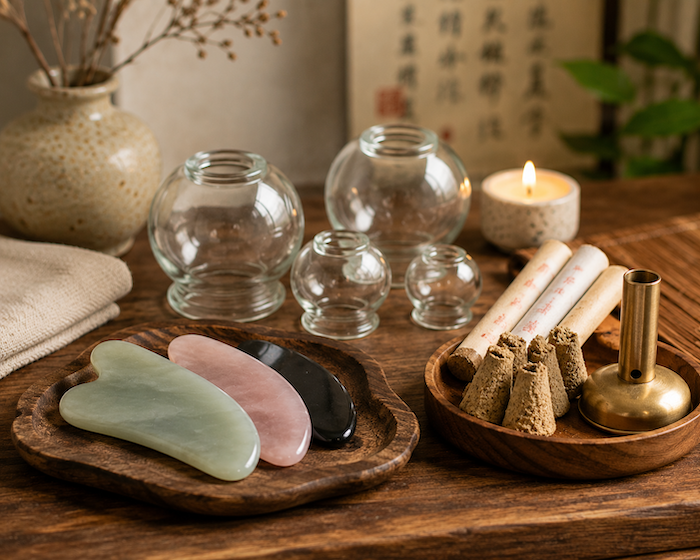
But acupuncture is just one part of the broader practice of Traditional Chinese Medicine (TCM). For thousands of years, practitioners have used additional techniques—including gua sha, cupping, and moxibustion—to support circulation, relieve muscular tension, promote relaxation, and restore balance in the body.
These therapies can be used on their own or combined with acupuncture depending on a person's symptoms, constitution, and treatment goals.
So what exactly are they?
Let's take a closer look at three of the most popular "beyond the needles" therapies.
WHAT IS GUA SHA?
Gua sha is a traditional technique that involves gently scraping the skin with a smooth-edged tool.
The practitioner applies oil or lotion to the skin and uses a specialized gua sha tool—often made from jade, stone, ceramic, or another smooth material—to make repeated strokes across the treatment area.
Gua sha is commonly used on areas such as:
Neck
Shoulders
Upper back
Lower back
Arms
Legs
It can also be incorporated into facial treatments.
WHAT DOES GUA SHA FEEL LIKE?
Gua sha should not feel like aggressively scraping the skin.
When performed properly, patients may experience a sensation of pressure, warmth, or mild tenderness.
The treatment can produce temporary red or purple-colored markings called sha.
These markings are not bruises in the traditional sense, although they can resemble bruising. They generally fade within several days.
WHY IS GUA SHA USED?
From a TCM perspective, gua sha is traditionally used to move Qi and Blood, release stagnation, and help resolve areas of tension.
In a modern treatment setting, practitioners may use it to address muscular tightness and discomfort.
Gua sha may be particularly appealing for people experiencing:
Neck tension
Tendonitis
Shoulder tightness
Muscle soreness
Back tension
Headaches associated with muscular tension
Limited mobility
General feelings of stiffness
The mechanical stimulation of the skin and underlying tissues may also influence local circulation and sensory nerve activity.
WHAT IS CUPPING?
Cupping therapy uses cups placed on the skin to create suction.
Traditionally, cups were made from materials such as bamboo, ceramic, or glass. Today, practitioners may also use modern plastic or silicone cups. I prefer the glass ones, as they work well for sliding cupping which is a technique I prefer.
The suction gently lifts the skin and superficial tissues underneath the cup.
Depending on the technique, cups may either remain stationary or be gently moved across the skin.
WHAT DOES CUPPING LOOK LIKE?
After cupping, you may notice circular red, pink, or purple marks where the cups were placed. Many practitioners are doing cupping now, but licensed acupuncturists are well trained in cupping techniques.
Cupping sometimes looks dramatic, but they generally aren't painful and should fade within several days. Not months!
The intensity and duration of the marks vary from person to person.
WHY DO PEOPLE GET CUPPING?
Today, cupping is commonly incorporated into treatments for:
Tight muscles
Back pain
Neck and shoulder tension
Muscle soreness
Athletic recovery
Feelings of stiffness
General relaxation
Many patients describe cupping as creating a feeling of "lifting" or decompression in areas that feel tight or congested. This is especially great for taking the pressure off a nerve compression, such as a very tight iliotibial band (ITBand)
MOVING CUPPING
Not all cupping leaves the cups in one place.
With moving cupping, the practitioner applies oil to the skin and gently glides the cup across the treatment area.
This technique can cover a larger area and is often used over the back, shoulders, or thighs.
Moving cupping can feel somewhat similar to a deep massage, although the sensation is produced through suction rather than pressure. I love this because it’s fantastic for moving lymph as well.
WHAT IS MOXIBUSTION?
Moxibustion, often simply called moxa, is a traditional therapy that uses heat generated from burning dried mugwort (Artemisia).
The practitioner uses the warmth of moxa to stimulate specific acupuncture points or areas of the body.
Unlike acupuncture, there are no needles involved in the actual moxibustion technique.
The defining feature is therapeutic warmth.
WHAT DOES MOXIBUSTION FEEL LIKE?
When performed correctly, moxibustion should feel pleasantly warm rather than painfully hot.
The practitioner carefully monitors the temperature and distance from the skin.
Patients often describe the sensation as:
Warm
Comforting
Deeply relaxing
Similar to having a gentle heat source near the body
Some people find moxibustion especially soothing during colder months.
WHY IS MOXIBUSTION USED?
In TCM, moxibustion is traditionally associated with warming the body's channels, supporting Yang, and improving the movement of Qi and Blood.
MOXIBUSTION AND THE FEELING OF COLD
Have you ever noticed that certain aches and pains feel worse when you're cold?
Warmth can be incredibly soothing to tense muscles and stiff joints.
Moxibustion provides a concentrated source of therapeutic heat, which can make it particularly appealing for patients who feel better with warmth.
Your practitioner may combine moxa with acupuncture to provide both needle stimulation and therapeutic heat during the same session.
HOW ARE THESE THERAPIES DIFFERENT?
Although gua sha, cupping, and moxibustion are all traditional TCM techniques, they work in very different ways.
Gua Sha
Uses: A smooth-edged tool
Main sensation: Scraping/pressure
Common goal: Release muscular tension and stimulate circulation
Typical result: Temporary red or purple markings. Great for scar tissue and detoxing.
Cupping
Uses: Suction cups
Main sensation: Pulling/lifting
Common goal: Relax tight tissues and stimulate local circulation
Typical result: Sometimes circular marks on the skin and relief of tight or stagnant old injuries
Moxibustion
Uses: Heat from burning mugwort
Main sensation: Warmth
Common goal: Warm and stimulate specific areas or acupuncture points
Typical result: Usually no visible marking, but warmth and stimulation.
CAN THEY BE COMBINED WITH ACUPUNCTURE?
Absolutely, and it’s often what I do.
One of the advantages of Traditional Chinese Medicine is that treatments can be customized.
For example, someone with chronic neck and shoulder tension might receive:
Acupuncture → Gua Sha → Gentle stretching
Another patient with tight lower-back muscles might benefit from:
Acupuncture → Cupping → Moxibustion
Someone who tends to feel cold and stiff might receive:
Acupuncture → Moxibustion
The treatment is selected based on the person's symptoms and overall TCM pattern.
WHY COMBINE DIFFERENT TECHNIQUES?
Different techniques provide different forms of stimulation.
Acupuncture primarily uses very fine needles to stimulate specific points.
Gua sha provides mechanical stimulation through the skin and superficial tissues.
Cupping creates negative pressure.
Moxibustion provides therapeutic heat.
Combining these techniques gives practitioners additional ways to work with areas of tension, discomfort, and imbalance.
Sometimes the best treatment isn't simply more needles—it's using the right combination of techniques.
ARE GUA SHA AND CUPPING PAINFUL?
Generally, neither should be excessively painful.
Some tenderness can occur, particularly when treating areas of significant muscular tension.
Cupping may feel like a strong pulling sensation.
Gua sha may feel like firm pressure moving across the skin.
Moxibustion should feel comfortably warm.
Your practitioner should always adjust the treatment based on your comfort level.
ARE THE MARKS NORMAL?
Yes.
Temporary skin discoloration can occur after both gua sha and cupping.
With gua sha, the markings can appear as small red or purple areas following the direction of the tool.
With cupping, marks are usually circular.
The appearance depends on factors such as:
Skin sensitivity
Treatment intensity
Duration
Local circulation
Individual response
The marks usually fade naturally.
ARE THESE TREATMENTS SAFE?
When performed by a properly trained practitioner using appropriate techniques, these therapies are generally considered safe for many people. Always seek a Licensed Acupuncturist! (L.Ac.)
However, they aren't appropriate for everyone.
Practitioners may modify or avoid certain techniques for people with particular medical conditions, medications, skin problems, bleeding risks, or other contraindications.
Moxibustion also requires careful temperature control because burning material is involved.
If you are taking medications that affect blood clotting, have a bleeding disorder, have fragile skin, or have another medical condition that could affect treatment, tell your practitioner before receiving gua sha or cupping.
WHAT SHOULD YOU EXPECT AFTER TREATMENT?
People respond differently.
Some patients feel immediately relaxed. Others notice that their muscles feel looser or their range of motion improves.
You might experience:
Relaxation
Warmth
Mild muscle soreness
Temporary skin discoloration
Reduced feeling of tightness
A sense of physical lightness
It's generally a good idea to stay hydrated and give your body some time to relax after a treatment.
BEYOND NEEDLES: A WHOLE-BODY APPROACH
One of the most interesting aspects of Traditional Chinese Medicine is that acupuncture doesn't have to be limited to needles.
Gua sha works through the skin and tissues.
Cupping works through suction.
Moxibustion works through warmth.
Each technique offers a different way of stimulating the body.
For patients who are curious about acupuncture but aren't sure whether needles are right for them, these therapies can also provide another entry point into the world of TCM.
FINAL THOUGHTS
Acupuncture may be the most recognizable part of Traditional Chinese Medicine, but it's only one piece of a much larger therapeutic system.
Gua sha, cupping, and moxibustion each have their own unique traditions, techniques, and applications. They can be used individually or combined with acupuncture to create a personalized treatment experience.
Whether you're dealing with tight shoulders, sore muscles, stiffness, stress, or simply looking for a deeply relaxing treatment, your acupuncturist can determine whether one of these techniques may be appropriate for you.
Sometimes healing doesn't require more needles - it requires the right technique for your body.